www.silverhillcreative.com

www.silverhillcreative.com is now live! Follow me there.

Wednesday, June 17, 2015

"Hat of the Week": Excited by "Boring" Hats

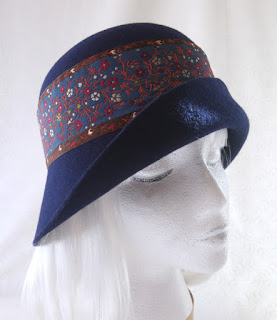
 Navy 1920s-style Cloche
Navy 1920s-style Cloche
It's Royal Ascot time. While the eyes of the hat-loving world are on amazing, often gravity-defying millinery creations, I'm thinking about ... the exact opposite.

As much as I love fancy hats, my heart truly belongs to casual hats. I'm a vintage gal at heart. It used to be that women wore hats every day, not just for weddings, races and fancy events. There's a charm to everyday hats. A lived-in feel that makes the hat part of the wearer, not just a decoration on top.

This past weekend was the 10th Annual Jazz Age Lawn Party in New York. (I've never been, and I so want to go sometime!) Most people who go dress up in their 1920s best — from authentic vintage to reproductions to costumes.

Evening ensembles with beaded dresses, metallic shoes, dark makeup and fancy headpieces are the most spectacular to look at. But would a 1920s woman, even the most modern flapper wear an evening outfit to a daytime picnic? Probably not. But I think a well-done historically accurate outfit can be just as exciting.

When most people think of flapper fashions, they most often picture what you get if you Google "flapper costume": fringed dresses and a sequined headband with a feather stuck in it. Sad. Flapper fashions were so much more than that. Some of them were comparatively plain, but still fashionable. (And let's not forget that not every woman — not even every stylish young woman — was a flapper.)

There's something about everyday hats that jazzes me up. (Pun intended.) When I saw the most recent Great Gatsby movie, my favorite hat was a barely glimpsed pink cloche on an extra. It was slightly battered looking. It wasn't slick and overly perfect. As a result, it looked like a real hat a woman from that era would wear. It didn't look like a costume.

This week's "Hat of the Week" is inspired by the real fashions of the 1920s. It's not 100% historically accurate. It's not based on a specific extant cloche. The trim is vintage, but I'd guess it's from the 1970s. This navy cloche, though, is 100% historically inspired. It's designed to be an everyday hat. And it pairs as well with jeans and a t-shirt as it does with a 1920s-style day dress.

A model shows off the navy "everyday" cloche.
Photo by Ting Shen
This hat is 30% off through June 22. No coupon code needed.

As always, I welcome any questions about my millinery process or inspirations.


Tuesday, June 9, 2015

"Hat of the Week": Beading ... and My Dirty Little Secret

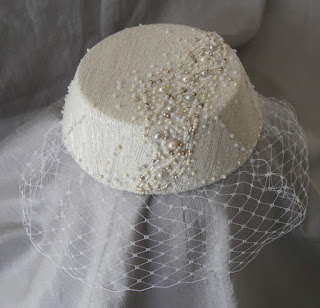
Beaded Bridal Headpiece with Veil
It's wedding season. (As someone who got married in gray November, I think every season can be wedding season. But June is a more popular month.) So it seems fitting that a bridal piece be this week's "Hat of the Week."

25% off. No coupon code needed. And back to regular price on Monday.

Best of all, it's ready to ship! So if you're a procrastinator or just planning a wedding in a short time, it's the perfect headpiece. And, hey, weddings are expensive. This hat — even at full price — is not.

This is a silk/cotton fabric with metallic threads on a buckram base. Also has a nylon veil and elastic to hold it in place.

But really, this hat is all about the beads. If you've seen some of my other hats, you might know I have a weakness for beads and beading. I have amassed a collection of many different beads. Sadly, my favorite bead store recently closed. This piece has several styles of beads: freshwater pearls; white, cream and iridescent seed beads; iridescent bugle beads, and vintage micro beads. All were sewn on by hand, a process that took many hours.

 And here's my dirty little secret: I don't charge for my time. Well, not exactly. I do charge for my time somewhat, but I base my prices more on the cost of materials.

It's part of my philosophy of pricing. I do what I think is fair — for me and for customers. I think nicer, higher quality materials should cost more. A simple silk tulle veil should cost more than an elaborately constructed nylon or polyester one. (Personally, I would never pay $100 for a polyester shirt, no matter the brand. But I would perhaps be willing to pay that amount for a silk shirt.) I don't think customers should have to pay more if a material misbehaved or I had to unpick some stitches.

So that's my dirty little secret. Also, I really like beading, so it's not as much "work" as certain other millinery tasks.

I'm newer to bridal millinery than I am to other aspects of hat-making. I never was the wedding-dreams, "bridezilla" type. That's probably why I didn't gravitate toward making bridal headpieces at first. But since I've done it, I can't wait to do more.

In my opinion, bridal work is the ultimate creative challenge as a milliner. It can be simple or elaborate. Usually, it's monochromatic, which forces more thoughtful decisions about texture and proportion. There are so many amazing places bridal hats can go. Check out my Bridal Hats board on Pinterest for some examples of what other milliners are doing with shades of white.

The veil drops to about cheekbone level.
As always, I welcome any questions you might have!

Wednesday, June 3, 2015

How to Wear a Hat

"I love hats, but I don't look good in them."
"I wish hats would come back in style."
"I just don't have any place to wear a hat."
"Everybody stares at me. I stand out."
"Hats don't fit my lifestyle."
"I can't find a hat that fits my weird head/face."

Remy doesn't like wearing hats.
But he's a dog. What's your excuse?
Other fashion experts and milliners have talked about this before. Here's my take. Here's how to wear a hat:

Decide You Want to Wear a Hat


The key word here is you. Don't worry about what other people are doing. Don't worry that you think hats aren't "in." First of all, they're more in than you think. If every person who says, "I wish hats would come back" actually wore a hat — guess what? — hats would officially be back. People aren't used to seeing hats everywhere, but they still like them. Second of all, unless you're in middle school, what other people think of your hat shouldn't be a concern. When I was in sixth grade, I thought if only I wore the right clothes, I would be popular. It didn't happen. Nobody's going to like you or dislike you because you wear a hat. And if they do, that says far more about them than it does about you.

If you want to wear a hat ... wear a hat! It's a simple as that.

Wear Red Lipstick, Part I (aka Don't Let the Hat Wear You)


Before I was a milliner, I worked as a makeup artist. The first time I ever wore a bright red lipstick, I was taken aback. Who was that person in the mirror? It was strange and uncomfortable ... at first. After about half an hour, I grew to love it! When I had women wanting to try red lipstick, they'd be nervous at first. I told them they just needed a little time to get used to it. Once they did, they could wear that bold lipstick with confidence.

And the same thing is true of hats. If you walk down the street ashamed of your fashion choices and feel insecure, if you think "Oh, everybody's staring at me because I'm wearing a hat!" then it isn't going to go well. "Why is she wearing a hat?" people might think, not because hats are odd but because you show your discomfort.

On the flip side, if you walk down the street pleased with your headwear and think "Heck yeah! I'm rocking this hat!" then you will feel great. You might get loads of compliments. ... And I guarantee you that at least one person will be thinking, "She can really pull off wearing a hat! I wish I could do that."

If you need to, wear a hat around your house to get used to it. Take lots of looks at your self in the mirror. Let wearing a hat feel cool and exciting, not embarrassing. And when you take it out in public, the #1 rule is this: You wear the hat. Don't let the hat wear you.

Wear Red Lipstick, Part II (aka When Style Does Matter)


emerald green '40s halo hat
You might want to pull out the
red lipstick and vintage hairstyle
for this 1940s-style hat.
If you grab a certain style of hat and just plop it onto your head, you might look kind of silly. Some kinds of hats require a certain type of outfit and/or hairstyle and/or makeup. Perching hats (such as the "doll hats" or "toy hats" of the 1940s) might look ridiculous with long, loose unstyled hair and jeans and a t-shirt. A pillbox stuck onto the back of your head will seem silly and out of place with no thought about makeup or clothes or hairstyle. Some hats require you to pay attention to the rest of your style. I advise starting with the hat and then figuring out the hair, makeup and outfit to match. And maybe wear that bold red lipstick for a truly vintage look.

But, the good news is there are plenty of modern "beginner" hat styles. Everyday, casual styles. Or, as I like to call them: jeans-and-a-t-shirt hats

Anybody who thinks they don't have a place to wear a hat is just plain wrong. Sure, you might not have an event that requires a wide-brimmed Kentucky Derby-style hat. Not everybody has a place to wear a sequined cocktail hat. But there are absolutely hats you can wear as easily as a ball cap.

The first hats I wore were probably newsboys and flat caps. From there, it wasn't much of a leap to wear fedoras/trilbies and cloches. A simple cloche or jaunty fedora can easily be worn with jeans and a t-shirt. 

You Can Be a "Hat Person"


"I don't look good in hats." "I'm just not a hat person." "I can't find a hat that looks good on me." "Hats always look silly on me." Milliners hear these all the time. 

And, sorry, but you're wrong.

"Saying you don't look good in hats is like saying you don't look good in shoes." I don't know who first said that. Sometimes it's expanded to include "You just haven't found the right hat yet."

An everyday fedora can go with
everything, even jeans and a t-shirt.
Another observation I love came from a fellow milliner. What would you do if you lived in the 1940s? You would find a hat that suited you because everyone wore hats. Period.

Obviously, not every hat is going to look good on every person. One of my favorite hat styles is the '40s style fedora that is a bit smaller than head-size, so it perches on top of the head. One of my favorite people is a woman who is 6' tall and has a 24.5" head size. If she wore this style of hat, it would probably look like she just has a too-small hat, rather than looking like the style. If you have a long, thin face, a high-crowned, wide-brim hat might not be the best match for you.

So experiment. See what you like. See what looks good. And milliners are not just hat makers. We're also hat stylists. I can help match you up with the best style for you. I can make a custom hat to suit your style. If you have an extra large or extra small head size, I can make a hat to your measurements. And if I'm not the right milliner to make the bespoke hat, I will refer you to another milliner who is.

* ~ * ~ *

As always, questions are welcome.

Tuesday, June 2, 2015

"Hat of the Week": Vintage Trims and Liars on eBay

Olive Straw Cloche
This week's "Hat of the Week" is an olive toyo straw cloche. As usual, the sale is until next Monday with no coupon code needed. Not as usual, this hat is the biggest discount I've yet offered: 40%. But it will go back to full price as of Monday.

And this week I want to talk about supplies, supplies-hoarding and vintage trims.

What's "new" on this hat? The body (made of toyo straw), the head size ribbon, the brand label and thread. Everything else, all of the trims are vintage.

I started buying and collecting vintage trims only about 3 years ago, and I have learned a lot in the process.

Vintage supplies come in two main forms. New old stock — also called NOS or deadstock — is old/vintage/antique but has never been used (therefore "new"). Reclaimed or rescued vintage components were used for another project, perhaps a dress or a hat, and later removed.

You would assume that NOS is in better condition than reclaimed. That's not always the case. "New" vintage materials can have damage from moths, dust, mold, etc. They can have foxing (the brown spots you see on old paper). Ribbons on the roll used to be sold with paper in between each layer. That might seem like a good thing, but the acid from the paper can cause the ribbon to weaken or deteriorate. That's especially important to know for listings where the ribbon hasn't been unrolled to check its condition or verify yardage.

Three types of vintage trim.
This week's hat has three types of vintage trim, so I thought it would be a good week to talk about vintage supplies.

First up, the band: I'm pretty sure this trim was reclaimed, because it had stray threads along the edges that indicated it had been sewn onto something else. (I bought this from ShopOlga on Etsy.) It was a pretty short piece, just 25". Some of the pale parts were a little dingy, so I gave it a wash before using it. And there are a couple of flaws in the weave, which I think are due to weaving errors (though possibly age).

It's a fascinating geometric pattern. The seller listed it as 1920s to 1930s, which I have no reason to doubt.

So here's the first caveat about vintage or antique trims: Lots of sellers try to suck you in by labeling something as older than it is. Sometimes there are clues such as "antique-colored" or "vintage style." And sometimes they'll straight-up lie. That's why it's good to take advantage of buyer protection on eBay or Etsy.

Part of the reason I know this ribbon is genuine vintage is because it has a high metal content. That means the bronze threads are actually metal! Modern metallic ribbons are just metal-colored, not made with metal. And you can tell (same as with steel beads vs. glass beads) just by the feel. Real metal is heavy. 
My favorite part of this hat is the pompom. I bought this set of five NOS pompoms on Etsy a couple years ago. The one at top left had a couple of spots I wasn't able to get out, so I used that one on a personal hat. The others are just beautiful and fabulous and fun! They don't make supplies like this anymore. It is fluffy and soft.

Finally, the ribbon used to bind the brim and make a small bow under the pompom. On the positive side, it matches the metal trim perfectly, and the texture is a perfect complement to the paper straw. On the downside, here was an example of a seller being quite inaccurate in a description. I refuse to pass the deception along, so I don't call it silk, rayon, satin or millinery ribbon. It is genuinely vintage and came on the original roll. 

I bought this trim more than two years ago. If I had it to do over again, I wouldn't have purchased it. I have become much better at identifying ribbon styles and quality from listing photos rather than just believing the description. Or I might have returned it for being "not as described." It was labeled as: 160" NOS Antique Silk Satin Rayon Copper/Gold Millinery Ribbon Spool. It was 160" of NOS ribbon on a spool. The color wasn't copper, but it was what I was expecting from the photos. Antique? Maybe. More likely vintage. (Vintage items are 20 years old or older. Antique means at least 100 years old.)

I don't know whether the seller was just ignorant and using certain words because she thought they rightly applied or whether she intentionally lied to make her item sound better. (In any case, I am the one who made the choice not to return it, so I can't blame her totally.)

This is not a satin ribbon. Satin does not mean shiny fabric, contrary to what many people think. It is a certain type of weave. This ribbon is a twill weave. It is also not a millinery ribbon, and that's probably the most misleading part of the description. This was most likely originally used and sold as gift wrap ribbon or floral ribbon or for other disposable purposes. It feels thin and stiff and papery. It's a lovely brim binding on a straw hat. But it couldn't stand on its own as a trim around the crown.

I don't know what this ribbon is made out of. It might be rayon. It probably isn't silk. Oh, silk! I love real silk, but that's one of the number one things to watch out for in vintage trim auctions/sales. Sellers love to list things as silk, even if they're not silk. Sometimes they'll call an item "silk" in the title and then later just call it "silky." Sometimes they'll say "silk ... made of polyester," which is baffling to me. And then sometimes they'll just sell it as 100% silk, when it's not. (I bought a vintage silk dress on eBay and returned it when it turned out to be acetate.)

As with most of my trims, I bought this bronze ribbon without any specific project in mind. So the inaccuracy didn't derail any grand plans I had for it. And I ended up finding a perfect use for it: accenting the edge of this hat! Despite my grumbling about the inaccuracy of the description, I kept it and discovered a lovely way to use it.

Questions about vintage supplies or my process in making this hat are welcome!

Tuesday, May 26, 2015

"Hat of the Week": Steel Beads!


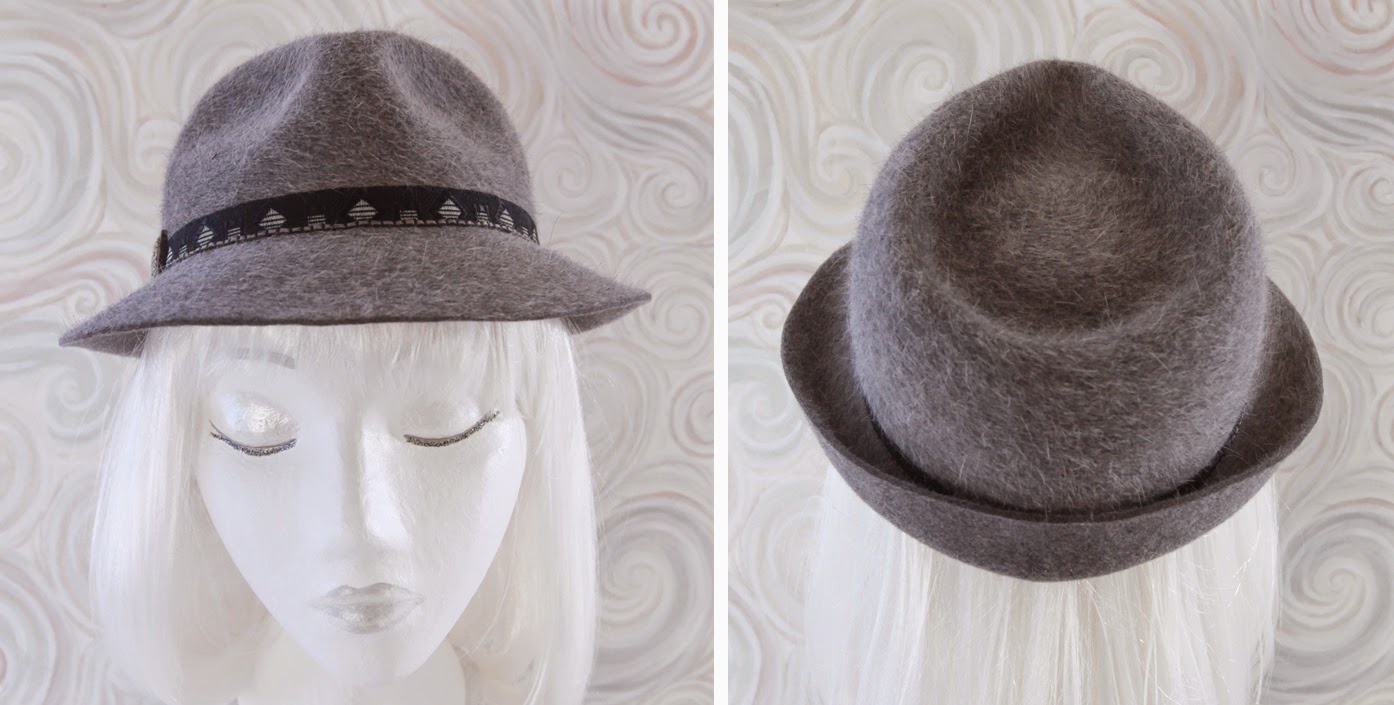
Jazzy Gray Felt Fedora

Okay, technically it could more accurately be described as a trilby. But how many people know that word? Not many. It's a fedora to almost everybody. In fact, pork pies are even called fedoras by a lot of people. Well, I'll save the nit-picking for another post. I call this hat both a fedora and a trilby in my description. Anyhow, this hat is 30% off, with no coupon code needed until next Monday.

 I have kind of an obsession with beads. I have well over 100 different styles of beads in my supplies. Most of those are glass seed beads. Some are semiprecious stones. The beads on this hat are something special, though.

The gray beads every few columns are just size 15 (i.e. very small) seed beads. But the other beads are what are called steel cut beads or French steel beads. They are tiny. And, yes, they are made of metal rather than metallic colored glass.

You might see steel beads embroidered onto vintage clothing or shoes. But the most common way to find them is vintage purses. Steel-beaded purses were very popular — especially in the 1910s and 1920s.

Want to put together an authentic Flapper costume? Forget the sequined headband and red fringed dress. Get yourself a beaded purse!

For these beads, I had bought a panel from an old purse. Even the vintage purses that are whole tend to need some repair work. And sometimes they have only remnants. I took this picture of the piece I bought. Gorgeous! But you can see how it's falling apart. And the fuzzies along the top are disintegrating, decaying threads.


I used beads from this panel to decorate the side of this hat. Obviously, I have plenty more left for future projects.

The trim is vintage, too. (Or possibly antique. It's very old.) At first glance it appears black and gray. But it's actually dark navy blue and pale mint green. I think it's silk and cotton, but I'm not certain. It's in lovely condition for its age and just beautiful trim.

Despite all the vintage fanciness, this hat is one of the most casual and wearable ones I've ever made. It can be worn straight or tipped forward or to the back of the head, depending on the style. It looks smashing with jeans and a t-shirt.

If you are interested in steel beads, check out French Steel Bead Shop on Etsy for beads and vintage bead purses.

As always, I welcome comments and questions about vintage supplies or the process of making hats.


Tuesday, May 19, 2015

"Hat of the Week": I Hate this Hat (but not really)

This week's "Hat of the Week." Mint parasisal straw cloche. 34% off. (I said before, I don't believe in tiny discounts.) No coupon code needed. And here's a bit about it.
Mint Parasisal Straw Cloche
Here's one of my dirty little secrets as a milliner: I don't love straw. I prefer the look of felt, and I much, much prefer working with felt. Felt is easier. It feels good to work with. Straw is tricky! Think of "Chinese" finger traps, how that weaving can cause the tube to change shape and get narrower or wider as it is pushed or pulled. That's what happens with parasisal woven straw at times. Or, if you're not careful, the weave can start to fray and unravel. So, I don't do as much work with straw.

This one, though, is a hat that I'm very happy to have made.

I used to hate pastels. Now, depending on the occasion, I can love them (... or not). But I think spring and summer call for light-colored hats. Mint green is much better for the season than black. But to keep it from being too cutesy and candy-colored, the band is a nice dark-colored contrast.

This is a vintage rayon ribbon I found on Etsy. I love it and wish I had a whole roll of the stuff! I have a weakness for vintage ribbons. Modern ribbons aren't nearly as nice. They tend to be cheap and stiff and made of polyester. Or, if they're quality rayon, silk, etc. they're very expensive.


The cloche shape here is a very 1920s style. I like to think it would be a perfect thing to wear to the Jazz Age Lawn Party.

As always, I'm happy to answer any questions about my process, etc.

Tuesday, May 12, 2015

"Hat of the Week": Experiment with Shapes

Wide Brim Asymmetrical Hat
This week's "Hat of the Week" is a huge 35% off (and with no coupon code needed): A wide-brim hat with an asymmetrical crown in khaki fur felt.

And here's a little about it ...

This is one of those hats that I consider an experiment in form and shape. Even with only a few crown shapes and a few brim shapes, they can be combined in dozens of different ways! Certain shapes I return to again and again. This hat, though, is currently the only time I've combined this particular crown with this brim.

The trim is vintage. I am kind of addicted to vintage trims and to geometric patterns, and this combines both, of course!

Part of the reason I chose this hat this week is because it's a perfect transitional hat between seasons. Here in Vermont, we had a few hot days, and then it turned cool and rainy. I love hats with this size of brim. It's wide enough to give your face some sun protection, but not so wide that it becomes a kite in the slightest breeze. And it can keep the rain off your face, too. I wouldn't recommend wearing it in a drenching downpour, but fur felt holds up pretty well to getting damp.

Another interesting thing about this hat is how it could fit different head sizes. For an average (small to medium) women's head size of 22"-22.5", it will fit fully down on the head in a modern style.

If you've ever looked at vintage photos from the 1930s and '40s, you might have noticed that women's hats often weren't worn down around their foreheads. Instead, they were made to be a bit smaller than head size, so they perched slightly. (Or, for the "toy hat" or "doll hat" style, they perched a lot!) So, for the gal with a 22.5"-24" head size, this hat could be worn in that vintage fashion.

That's all for this "Hat of the Week." But I am happy to answer any questions about this hat, how it was made, etc.